Vacuum Mould Sets
Lower and upper mould, screen surface and vacuum channels; the hole pattern is calculated per product so the pulp is drawn evenly.

Erem Makina manufactures spare parts for industrial machinery, above all for the egg tray machines and egg tray production lines we build ourselves. Working from a sample part or a technical drawing, we produce to measure so that a worn part can be replaced without waiting for an import. Manufacturing takes place in our own workshop in İkitelli OSB, on our own CNC machines.
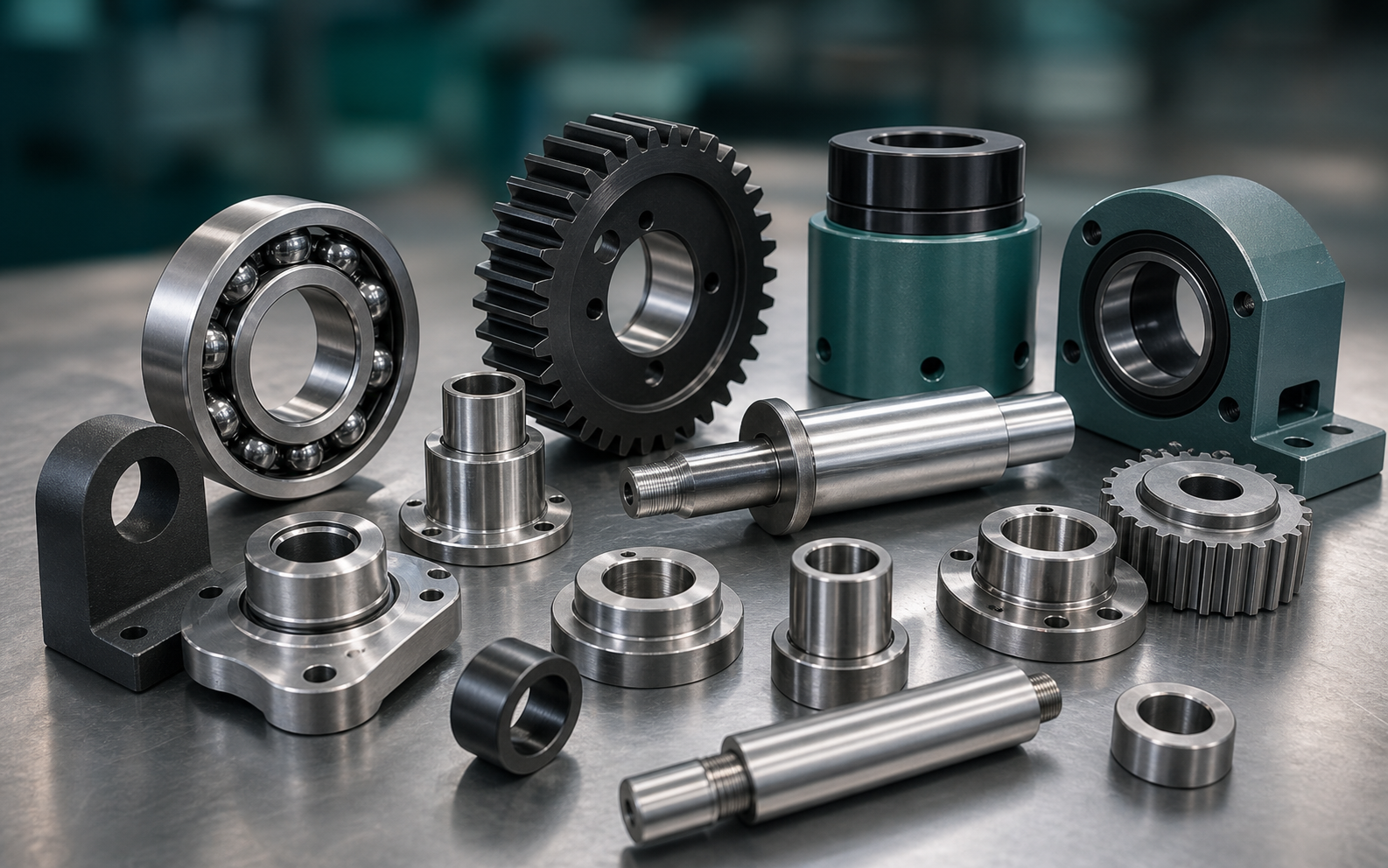
On an egg tray production line, most unplanned stoppages come down to a limited number of wear parts. The line consists of the pulper, vacuum moulding, drying oven, hot press and stacking units. Each unit works under a different kind of stress, so the parts that wear out differ as well; that is why we draw up the spare part list unit by unit rather than for the line as a whole.
On the pulper side, constant contact with water and paper fibre is abrasive; the agitator components and the seals are the parts most often replaced. In the vacuum moulding group, the mould surface, the screen and the vacuum seals face both mechanical load and moisture. In the drying oven the decisive factor is temperature: chains, rails and fan components reach the end of their life through thermal expansion and fatigue.
The hot press, which comes after drying and corrects the form of the already dried tray, carries pressure and heat at the same time; its press mould and guide elements need regular inspection. On the stacking and transfer units, failure is usually gradual rather than sudden: the conveyor belt, the chain and sprocket set and the suction cups first drift out of alignment and then stop the line.
| Unit | Typical spare parts | What drives the wear |
|---|---|---|
| Pulper | Agitator components, shaft seal, sealing parts | Abrasive action of water and paper fibre |
| Vacuum moulding | Mould set, screen, vacuum seal, drum bearing | Continuous vacuum and a damp working environment |
| Drying oven | Chains, rails, fan blades, carrier trolleys | High temperature and thermal expansion |
| Hot press | Press mould, guide column, cylinder and seals | The combined effect of pressure and heat |
| Stacking and transfer | Conveyor belt, chain and sprocket set, vacuum suction cup | Constant motion and mechanical fatigue |
| Drive group | Bearings, couplings, gearbox parts | Continuous rotation under a varying load |
Critical spare parts are held in stock; parts that are not in stock, or are specially machined, are remade from the technical drawing in our archive. On a line we built ourselves, this is why downtime is usually measured in hours rather than days.
The mould is the part that most directly determines tray quality — and changing product means changing the mould set.
The pocket depth, wall thickness, edge form and stackability of a tray are all set by the mould geometry. A mould set consists of a lower and an upper half, the screen that forms the surface, and the channel layout that distributes the vacuum. How the vacuum holes are distributed decides whether the pulp is drawn evenly onto the surface; when holes become partly blocked, one area of the tray stays thick and another thin, and that difference shows up both in weight and in drying time.
We build the mould around the product: separate sets are prepared for cup trays, lidded egg trays and industrial trays. On the same machine you change the product type by changing the mould set; a mould change is short enough to be completed within a single shift. Hot press moulds, which correct the form after drying, are machined from a material that holds its dimensions under heat.
A worn mould rarely has to be replaced outright. Cleaning the screen surface, opening blocked vacuum holes and re-machining the areas that have drifted out of tolerance can extend the life of the mould; which route is more economical we decide together, after seeing the part.
Lower and upper mould, screen surface and vacuum channels; the hole pattern is calculated per product so the pulp is drawn evenly.
Press moulds that correct the form after drying, machined to hold their dimensions under heat.
Mould sets for cup trays, lidded egg trays, industrial trays and custom products made to a sample.
Extending mould life by cleaning the screen, opening blocked vacuum holes and correcting dimensions.
A sample part, a technical drawing or an assembly photo — we start from whichever you have.
In made-to-measure production the critical step is deriving the correct dimension from a worn part. A worn surface no longer gives the nominal size, so we verify the dimension not only on the part itself but also on what it mates with: the bearing seat, the shaft diameter, the seal groove. Where a part is broken, the missing geometry is reconstructed from an assembly photo and from the dimensions of the neighbouring parts.
The second critical step is material. When two parts that look identical are made from different materials, early failure is inevitable; on rubbing surfaces, on parts working in a wet environment and on load-carrying shafts, the choice of material decides service life directly. Where a part has to be hardened or coated, the machining allowance is left with the post-treatment dimensional change already taken into account.
You send the failed part, its drawing or an assembly photo; we establish which unit it belongs to and what load it works under.
Worn surfaces are verified against the mating parts, and a manufacturing drawing is produced and archived.
Material is selected for the operating conditions; the machining sequence, the allowance and any heat treatment are planned accordingly.
The part is machined on our own CNC equipment, checked dimensionally and sent by domestic courier or export shipment.
Send a photo of the part, its technical drawing or the details of the machine, and we will come back to you with dimensions, material and a delivery time.